
Johns Hopkins UniversityEst. 1876
America’s First Research University
Now Browsing:
From Artemis to Voyager: The Physics That Powers Space Exploration
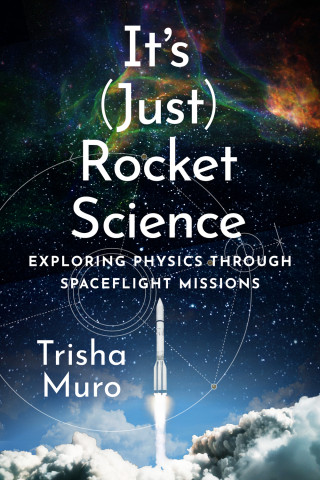
When NASA’s Artemis missions send humans back to the Moon—and eventually onward to Mars—they’ll capture headlines for their scale, ambition, and sheer audacity. But behind every launch and every image from deep space lies something less visible: the physics that makes it all possible. Not the kind buried in dense equations, but the kind that explains why rockets rise, how spacecraft travel vast distances, and what allows us to explore beyond Earth at all. That’s where It’s (Just) Rocket Science comes in.
Artemis feels like a new chapter in space exploration, but it also reminds us how much has always depended on understanding the rules of the universe. Every trajectory, every orbit, every successful landing comes down to a handful of core ideas. Trisha Muro’s book opens those ideas to readers who have ever watched a launch and wondered what’s really going on. Rather than asking readers to master physics first, she uses space missions as the entry point. Familiar stories lead the way, and the science follows. She uses real missions to convey key principles of math and physics, helping readers connect those ideas to their everyday lives.
The book moves through the building blocks of spaceflight in a way that mirrors the journey itself. It begins with gravity, the force that shapes everything from falling apples to planetary systems. From there, readers move into launches, orbits, and the challenge of leaving Earth. Later sections explore collisions, energy, and the behavior of light. Each concept is grounded in a real mission:
- JWST shows how gravity can create delicate balances in space
- Perseverance highlights the complexity of landing on Mars
- DART explores how scientists might shift an asteroid’s path
- Voyager helps frame our place in the wider universe
Seeing those connections changes how the missions look. A launch becomes more than a moment of spectacle. It becomes a visible expression of ideas that apply far beyond spaceflight. It’s (Just) Rocket Science offers a way into physics that feels grounded and relevant. By starting with real missions and real challenges, Muro replaces abstraction with context. The book doesn’t simplify the science so much as reposition it. Readers encounter the same core ideas, but through stories that make them easier to follow and harder to forget. The next time Artemis lifts off, you may find yourself noticing more than the rocket. You might see the interplay of forces, the careful management of energy, and the precision behind every movement. And once you start seeing those patterns, they tend to stay with you.
Each chapter builds from a specific scenario, then widens to reveal the underlying physics. Muro's background as a teacher helps her make the ideas challenging but still approachable. Concepts unfold step by step, with clear connections between them, rather than appearing all at once.
The book aligns naturally with renewed interest in space exploration. Artemis has brought public attention back to the mechanics of getting beyond Earth, even if those mechanics often stay behind the scenes. The same principles explored in the book are at work in every stage of these missions:
- The balance of forces that allows a rocket to leave Earth
- The calculations that guide a spacecraft into orbit
- The energy constraints that shape how far we can travel
Whether readers are seasoned stargazers or hesitant explorers, It's (Just) Rocket Science invites you to see the science behind space exploration —and recognize how those missions connect back to us.

Login to View & Leave Comments


The U.S. at 250: A Semiquincentennial Reading List
The United States of America turns 250 years old this July — and in that time a lot of history was made!To commemorate the occasion, we dove into our catalog to surface a selection of the books and journals published by Hopkins Press exploring milestone events...

Login to View & Leave Comments