Johns Hopkins UniversityEst. 1876
America’s First Research University
Now Browsing:
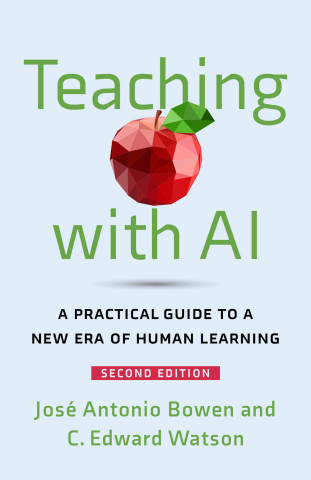
Teaching in the Age of AI: The Essential Guide for 2025 and Beyond
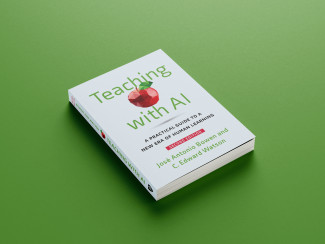
When Teaching with AI appeared in spring 2024, it quickly became the go-to resource for faculty trying to make sense of generative AI’s impact on teaching and learning. Its clear explanations, practical strategies, and level-headed optimism resonated with instructors.
But as José Antonio Bowen and C. Edward Watson argue, the pace of change in higher education is now tied to the pace of change in AI—and that means educators need guidance that evolves just as quickly. The authors have spent the past year travelling to campuses, running workshops, and talking with thousands of faculty. That collective experience has shaped a substantially updated second edition designed to help instructors respond to the newest wave of challenges and opportunities.
The new edition keeps the successful structure of the first book but updates examples, expands strategies, and adds timely new material, including an entirely new chapter on ethics, privacy, and the environmental realities of AI.

What’s New in the Second Edition?
A fully updated blueprint for an evolving technology
AI literacy looks different today than it did even a year ago. The second edition revises and expands early chapters to reflect the newest tools, new models, and new forms of student use. Faculty will find clearer guidance on what AI can (and cannot) do, along with strategies for evaluating AI-generated output—skills increasingly essential for students across disciplines.
A brand-new chapter on ethics, privacy, and the environment
This edition adds a much-requested chapter addressing questions that have become urgent on campuses:
- How should instructors help students navigate the ethics of using AI responsibly?
- What data do AI tools collect, and how should institutions guide students in protecting their privacy?
- What do we know about the environmental costs of generative AI—and what does responsible use look like in light of those impacts?
This new chapter doesn’t warn faculty away from AI; instead, it equips them to lead thoughtful, values-driven conversations.
A brand-new chapter on custom bots
The second edition also includes important information on custom bots, an entirely new technology that didn't exist when the first edition was published. The authors discuss the use and implications of this new technology in the classroom.
More tools and techniques for course prep, grading, and student support
The new edition expands coverage of:
- AI-assisted research for instructors
- Course design and assignment creation
- Nuanced alternatives to unreliable AI-detection tools
- Strategies for reducing cheating by increasing transparency, trust, and belonging
A strengthened focus on learning
One of the first edition’s greatest strengths was its insistence that AI should enhance—not replace—human learning. The second edition deepens that attention to learning design, offering:
- New examples of feedback loops between students and AI
- More guidance on designing assignments that reward authentic human thinking
- Expanded discussion of custom bots, simulations, and role-playing tools
The authors continue to frame AI as a collaborator in creativity and critical thinking rather than an efficiency tool.
Why Faculty Are Turning to This Book
The first edition became a bestseller because it spoke directly to what educators were experiencing: rapid change, genuine uncertainty, and the pressure to respond thoughtfully for their students’ sake.
The second edition builds on that foundation, offering clarity at a moment when AI’s capabilities and limitations are evolving almost weekly.
Across disciplines, faculty are asking:
- How do I prepare students for a world where AI will shape their future work?
- How do I redesign my course so AI is an asset, not a threat?
- How do we protect academic integrity without policing students into fear?
- What does good teaching look like now?
Bowen and Watson offer not just answers but frameworks, examples, and a mindset of curiosity and care. Their message remains steady: AI is fundamentally reshaping education. And educators can lead that transformation.
For Faculty, CTLs, and Anyone Teaching in 2025 and Beyond
Whether you’re just beginning to experiment with AI or already rethinking your assignments and assessments, the second edition of Teaching with AI is an essential companion. It’s practical, rich with examples, and refreshingly honest about both the promise and the pitfalls of this rapidly shifting landscape.
Higher education is entering a new era. Bowen and Watson’s updated guide helps every instructor step into that future with confidence, creativity, and care.

Login to View & Leave Comments
Callaloo presents: A bell hooks reading list
This spring, Vice President JD Vance announced the release of his new memoir, Communion, prompting a grassroots social media campaign that urged readers to—as The Word Is Change bookstore in Bed-Stuy, Brooklyn put it—“make sure if any book called Communion...


Login to View & Leave Comments