Johns Hopkins: The First 150 Years

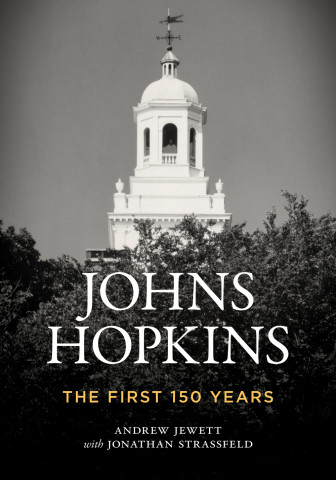
The definitive history of the first American research university.
The Quaker merchant Johns Hopkins set in motion a revolution when he left what was then the largest philanthropic gift in the US: a $7 million bequest to found a university and hospital. In Johns Hopkins: The First 150 Years, historian Andrew Jewett, with Jonathan Strassfeld, captures the sweeping evolution of an institution that rose from the bustle of a post–Civil War port city to become a global titan of discovery and innovation.
The book begins with a vivid portrait of Hopkins himself, whose life embodied the economic dynamism and deep moral tensions of nineteenth-century Baltimore. Jewett and Strassfeld then turn to the story of how the university's trustees worked with visionary leader Daniel Coit Gilman to establish original research and graduate training as defining features of American academic life—previously centered on classical education for undergraduates—and to position Hopkins as a global innovator in both the sciences and the humanities. The authors move beyond the lecture hall and the laboratory to track the university's often turbulent ascent, chronicling the birth of modern medical education and the rise of world-leading programs in nursing, engineering, and public health, later followed by international studies, music, education, business, and public policy.
This expansive chronicle also looks candidly at the university's complex relationship with its home city of Baltimore, examining its changing role in debates over race and equity and its emergence as a major economic and political player. The definitive history of Hopkins reveals an institution grappling with the heavy responsibilities arising from its influence and power. It is a story of ambition, conflict, innovation, and reinvention—an authoritative and essential account of a university that continues to reshape the world.
Introduction

Ch. 1 - Experiments

Ch. 1 - Experiments



Reviews
Book Details
x
Preface: A University for Outsiders
Introduction: A University for Baltimore
Part I: A Hopeful Youth, 1875–1901
1. Early Experiments, 1875–1883
2. Additions and Adjustments, 1883–1890
3. New Beginnings, 1890–1901
Part II: A Season of Struggle, 1901–1941
4. Consolidation, 1901–1916
5. War and Prosperity, 1916–1929
6. Hard Times, 1929–1941
Part III: The Social Compact, 1941–1956
7. Global War, 1941–1948
8. Permanent Mobilization, 1948–1956
9. Size and Spirit, 1948–1956
Part IV: Small but Superb, 1956–1988
10. The Era of Good Feelings, 1956–1967
11. Navigating the Sixties, 1967–1971
12. International and Big Time, 1971–1988
Part V: To Build Anew, 1988–2019
13. Structural Shifts, 1988–1996
14. Campus and Community, 1996–2007
15. Cultural Change, 2007–2019
Conclusion: The Compact Broken?
Acknowledgments
Notes
Index