Johns Hopkins UniversityEst. 1876

America’s First Research University

Back to Results
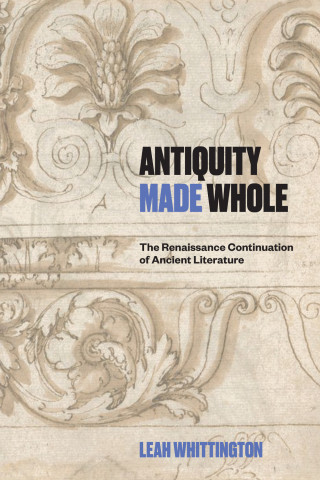
Cover of "Antiquity Made Whole" by Leah Whittington, featuring a beige sketch of Renaissance-style frieze floral scrolls with bold black and blue title text.
Preorder
Cover of "Antiquity Made Whole" by Leah Whittington, featuring a beige sketch of Renaissance-style frieze floral scrolls with bold black and blue title text.
Share this Title:

Antiquity Made Whole

The Renaissance Continuation of Ancient Literature

Leah Whittington

Publication Date

How Renaissance writers reimagined the ancient world, one fragment at a time.

Across the European Renaissance, ancient literature circulated in damaged, incomplete, and fragmentary forms. Missing lines, lost endings, and textual gaps were not obstacles to reading the classics; instead, they were invitations to fill in the blanks. In Antiquity Made Whole, Leah Whittington studies the practice of composing supplements, continuations, and completions composed for such works and places this practice at the center of Renaissance literary culture.

Whittington uncovers a neglected literary archive in...

How Renaissance writers reimagined the ancient world, one fragment at a time.

Across the European Renaissance, ancient literature circulated in damaged, incomplete, and fragmentary forms. Missing lines, lost endings, and textual gaps were not obstacles to reading the classics; instead, they were invitations to fill in the blanks. In Antiquity Made Whole, Leah Whittington studies the practice of composing supplements, continuations, and completions composed for such works and places this practice at the center of Renaissance literary culture.

Whittington uncovers a neglected literary archive in which authors set out to restore and revive antiquity through creative means. Though often overlooked in studies of classical transmission and reception, supplements appeared in manuscripts and printed books wherever classical literature was studied and published between 1400 and 1700. These texts were closely tied to the scholarly practices that defined early classical scholarship, sharing methods and materials with textual criticism, translation, and imitation. Studying ancient writers such as Vergil, Plautus, and Cicero alongside the early modern authors who wrote in the gaps, from Maffeo Vegio to Chaucer, Spenser, and Thomas May, Whittington shows how supplement writers worked across historical and fictional registers. Their work helps to refine modern distinctions between literary creativity and historical scholarship and reveals how Renaissance readers understood preservation as an active, generative process.

By situating supplements within the history of philology, Antiquity Made Whole offers a new account of Renaissance classical culture and its afterlives, providing timely insight into contemporary debates about restoration, conservation, and the stewardship of the past.

Reviews

Reviews

A tour-de-force study of the 'supplements' and continuations that Renaissance scholars and poets composed to complete unfinished or otherwise fragmentary classical texts, Antiquity Made Whole offers a learned and wide-ranging reassessment of the relationship between humanist philology and early modern poetics and a strikingly original account of the revival of classical antiquity.

Whittington's study of Renaissance 'supplements' reveals what lies on the other side of the fragment: a laboratory where textual reconstruction merges with creative imagination. Antiquity Made Whole offers a fresh reassessment of philology's imaginative dimensions while challenging entrenched notions of authorship, originality, and the porous boundaries of the classical past.

Old stories of literary loss and revival are transformed in this highly original exploration of the 'supplement,' which deploys a wealth of fresh work on textual and bibliographic history in chapter upon chapter of dazzling and theoretically innovative readings. Life-enhancing philology, a major gift to Renaissance and Classical Studies alike. 

Expansive, erudite, and beautifully written, Antiquity Made Whole brings together an astonishing range of texts and traditions, tracing connections between, for instance, the literary impersonation of the dead, the patchwork experimentation of philology, the discovery of English vernacular poetics among the ruins, and the 'completion' of ancient works of art with the help of AI. A brilliant achievement.

Any student of Renaissance literature will want to read this book.

About

Book Details

Release Date
Publication Date
Status
Preorder
Trim Size
6
x
9
Pages
520
ISBN
9781421455013
Illustration Description
26 b&w illus.
Table of Contents

Contents
List of Illustrations
Note on Texts and Translations
Abbreviations
Epigraph
Introduction: Completed Works
1. Impersonating Vergil: Maffeo Vegio and the Poetics of Reanimation
2. The Complete Text

Contents
List of Illustrations
Note on Texts and Translations
Abbreviations
Epigraph
Introduction: Completed Works
1. Impersonating Vergil: Maffeo Vegio and the Poetics of Reanimation
2. The Complete Text: Reconstructing Plautus from Manuscript to Performance
3. Patches, Insertions, and Repairs: Creativity and Historical Practice in Renaissance Classical Scholarship
4. Supplements and Superfluity in the Hero and Leander of Christopher Marlowe and George Chapman
5. Chaucer Increased: Editors, Poets, and the Invention of the Renaissance Squire's Tale
Epilogue: Feeble Shades
Acknowledgements
Notes
Bibliography

Author Bio
Featured Contributor

Leah Whittington

Leah Whittington is a professor of English at Harvard University. She is the author of Renaissance Suppliants: Poetry, Antiquity, Reconciliation.