Johns Hopkins UniversityEst. 1876

America’s First Research University

Back to Results
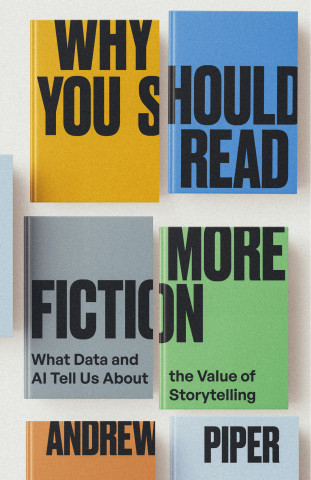
Cover of "Why You Should Read More Fiction" by Andrew Piper, featuring bold black typography across yellow, blue, gray, and green color-blocked book covers.
Preorder
Cover of "Why You Should Read More Fiction" by Andrew Piper, featuring bold black typography across yellow, blue, gray, and green color-blocked book covers.
Share this Title:

Why You Should Read More Fiction

What Data and AI Tell Us About the Value of Storytelling

Andrew Piper

Publication Date
Binding Type

Why human storytelling matters: the science behind attention, memory, and connection.

How do the stories we read shape the ways we think, perceive, and navigate the world? In this ambitious and timely book, Andrew Piper argues that fiction is far more than entertainment. Stories cultivate attention, perspective, and embodied understanding in ways increasingly vital to modern life.

Piper is the director of McGill University's ".txtlab," a digital humanities laboratory that uses AI and computational modeling to study how storytelling works. Rather than using AI to generate fiction, Piper employs...

Why human storytelling matters: the science behind attention, memory, and connection.

How do the stories we read shape the ways we think, perceive, and navigate the world? In this ambitious and timely book, Andrew Piper argues that fiction is far more than entertainment. Stories cultivate attention, perspective, and embodied understanding in ways increasingly vital to modern life.

Piper is the director of McGill University's ".txtlab," a digital humanities laboratory that uses AI and computational modeling to study how storytelling works. Rather than using AI to generate fiction, Piper employs these tools to analyze patterns across thousands of novels, folk tales, fan-fiction archives, and works of contemporary global literature. By translating elements of narrative—characters, emotions, objects, behaviors, social relationships, and points of view—into measurable features, his lab can identify patterns that no individual reader could easily detect through ordinary reading alone. Across these diverse traditions of storytelling, Piper demonstrates that fiction consistently foregrounds lived experience: characters moving through richly textured environments, objects charged with emotional and cognitive significance, worlds rendered through accumulated sensory detail. These patterns reveal fiction's distinctive ability to model how minds and bodies engage with their surroundings. Piper connects these findings to the cognitive science concept of embodied cognition, or the idea that thought emerges through our physical and emotional engagement with the world.

Fiction, he argues, does more than immerse us in imagined worlds. It trains us to examine experience with greater flexibility, attention, and interpretive distance. By coordinating our attention around the lives of others across cultures and centuries, stories help us inhabit perspectives that would otherwise remain inaccessible. At a moment when AI is reshaping how we think about language and creativity, Why You Should Read More Fiction offers a powerful defense of human storytelling and reading.

Reviews

Reviews

Just as we novelists were starting to despair that AI would take over our livelihoods, Andrew Piper swooped in with this brilliant, fascinating analysis of how LLMs and textual data analysis actually reveal the profound importance of embodied, human storytelling. I loved this book and will be gifting it to all my favorite writers and AI-phobes.

Why You Should Read More Fiction is a new kind of book—one that turns scientific research on narrative into a vivid, insightful account of the difference stories make for their readers. Beautifully written and genuinely new, this book will enrich the experience of anyone who enjoys thinking about fiction.

Piper has a deep understanding of narrative theory and embodied cognition, and his use of computational techniques is imaginative and bold, even as he is wary of their limitations. The result is a fascinating and persuasive new account of why stories matter.

With characteristic empirical ambition, Piper turns the computational study of fiction toward its most consequential question: what fiction actually does to the minds that read it. A significant contribution, and one that will shape how scholars think about fiction's cognitive work.

About

Book Details

Release Date
Publication Date
Status
Preorder
Trim Size
5.5
x
8.5
Pages
224
ISBN
9781421455037
Illustration Description
18 b&w illus.
Table of Contents

Introduction
1. Distant Worlds
2. Perceiving Perception
3. What Do Characters Do?
4. Things and Other Cognitive Niches
5. The Shape of Stories
6. Your Mind on Fiction
Coda: The Discipline We Need
Datasets
Note

Introduction
1. Distant Worlds
2. Perceiving Perception
3. What Do Characters Do?
4. Things and Other Cognitive Niches
5. The Shape of Stories
6. Your Mind on Fiction
Coda: The Discipline We Need
Datasets
Notes
Bibliography
Index

Author Bio
Andrew Piper
Featured Contributor

Andrew Piper

Andrew Piper is a professor in the Department of Languages, Literatures, and Cultures at McGill University. He is the author of Enumerations: Data and Literary Study, Book Was There: Reading in Electronic Times, and Dreaming in Books: The Making of the Bibliographic Imagination in the Romantic Age.