Johns Hopkins UniversityEst. 1876

America’s First Research University

Back to Results
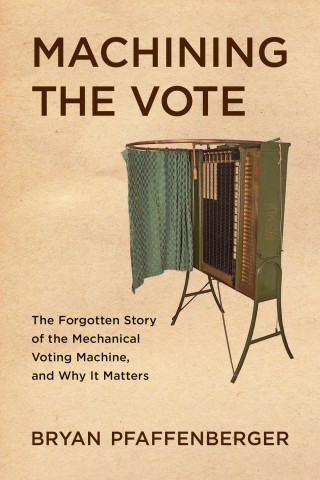
Cover of "Machining the Vote" by Bryan Pfaffenberger, featuring a vintage mechanical voting machine with green curtain against a vintage ballot card background.
Preorder
Cover of "Machining the Vote" by Bryan Pfaffenberger, featuring a vintage mechanical voting machine with green curtain against a vintage ballot card background.
Share this Title:

Machining the Vote

The Forgotten Story of the Mechanical Voting Machine, and Why It Matters

Bryan Pfaffenberger

Publication Date

How a hulking machine helped build and sustain American democracy in the mid-twentieth century.

For more than a century, the mechanical lever voting machine stood in polling places across the United States. Unwieldy, unloved, and eventually discarded, it rarely attracted admiration. Yet as Bryan Pfaffenberger shows, this "lowly lever" shaped American democracy in profound ways.

Machining the Vote traces the lever machine's rise from the contested elections of the late nineteenth century through its dominance in the twentieth century and its eventual demise in the era of digital voting...

How a hulking machine helped build and sustain American democracy in the mid-twentieth century.

For more than a century, the mechanical lever voting machine stood in polling places across the United States. Unwieldy, unloved, and eventually discarded, it rarely attracted admiration. Yet as Bryan Pfaffenberger shows, this "lowly lever" shaped American democracy in profound ways.

Machining the Vote traces the lever machine's rise from the contested elections of the late nineteenth century through its dominance in the twentieth century and its eventual demise in the era of digital voting. Pfaffenberger begins with the political crises that prompted inventors such as bank safe maker Jacob Myers to design a new system combining mechanical innovation with new election laws. He follows the fierce patent battles, corporate struggles, and legal fights that turned the lever machine into a near-national infrastructure, closely intertwined with New York election law and urban machine politics. Voting machines, Pfaffenberger argues, are political artifacts: they embody legal assumptions, administrative procedures, and cultural values. Lever machines promised to eliminate fraud, prevent overvoting, and enforce uniform procedures, because the machines were so transparent; technicians and precinct officials could easily recognize tampering. A former designer of bank vaults during the heyday of daring bank robberies, Myers understood the need to develop a security process capable of identifying exploits. Their gradual replacement by electronic systems—often without equivalent legal and procedural safeguards—set the stage for new controversies, culminating in the turmoil of the 2000 presidential election.

Bringing together political history and science and technology studies, Machining the Vote offers a cultural analysis of how technologies are selected, stabilized, and abandoned. At a moment when election integrity is fiercely debated, this book provides essential historical perspective on how machines—and the laws surrounding them—shape the practice of democracy.

Reviews

Reviews

In writing the history of the lever voting machine, Machining the Vote is a stellar contribution to the history of technology and to political science.

The description of the lever voting machine, Machining the Vote, is a significant historical contribution to current understanding of how election systems work. It provides a guide, going forward, of how to protect the integrity of each person's vote selection.

About

Book Details

Release Date
Publication Date
Status
Preorder
Trim Size
6
x
9
Pages
320
ISBN
9781421455990
Illustration Description
31 b&w illus.
Table of Contents

Table of Contents
Preface and Acknowledgments
Introduction
Part One: The Technological Drama, 1888-1898
1. The 19th Century's Florida 2000: The 1888 Presidential Election and the Rise of the Australian

Table of Contents
Preface and Acknowledgments
Introduction
Part One: The Technological Drama, 1888-1898
1. The 19th Century's Florida 2000: The 1888 Presidential Election and the Rise of the Australian Ballot
2. An Honest Ballot Freely Cast: Jacob Myers's Heterogeneous Invention
3. Protecting the Freeman's Will: The Battle to Establish the Voting Machine's Legality
4. A Fatal Objection: Myers' Downfall
5. Divide and Conquer: The Road to the Lever Voting Machine
Part Two: The Patent War (1898-1914)
6. Voting Machine Trust: The Struggle to Control the Lever Machine
7. The Voting Machine Combine: Preventing Others from Selling a Practical Voting Machine
8. Competition, Merger Mania, and the Road to Monopoly
Part Three: The Lever Machine Infrastructure, 1915-2008
9. Absolute Security: The Marriage of Machine and Law
10. Machine Politics: Tammany Hall's War Against the Voting Machine
11. Voting Machines Strike Back: Fusion Voting and Tammany's Demise
12. Voting Machines and Boss Rule: From Statewide System to Big-City Fraud Protection
13. Boom and Bust: The Rise and Fall of the National Lever Machine Infrastructure
14. The Struggle to Retain Lever Voting Machines: New York State
Conclusion: The Lever's Lessons

Author Bio
Featured Contributor

Bryan Pfaffenberger

Bryan Pfaffenberger is a retired anthropologist and science and technology studies scholar who taught science, technology, and society at the University of Virginia. He is the author of Democratizing Information: End-User Searching and the Rise of Online Databases.