Johns Hopkins UniversityEst. 1876

America’s First Research University

Back to Results
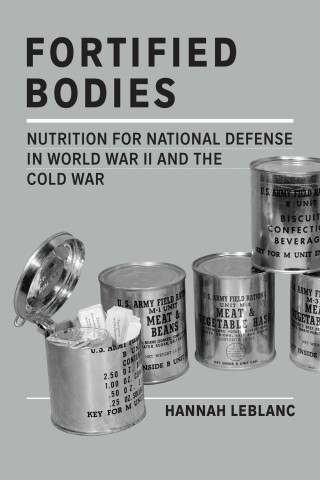
Cover of "Fortified Bodies: Nutrition for National Defense in World War II and the Cold War" by Hannah LeBlanc, featuring grayscale U.S. Army ration cans with visible ration tickets inside.
Preorder
Cover of "Fortified Bodies: Nutrition for National Defense in World War II and the Cold War" by Hannah LeBlanc, featuring grayscale U.S. Army ration cans with visible ration tickets inside.
Share this Title:

Fortified Bodies

Nutrition for National Defense in World War II and the Cold War

Hannah LeBlanc

Publication Date

Nutrition science, national power, and the politics of feeding the world.

In the twentieth century, nutrition became a matter not only of health, but of national security, economic development, and global governance. In Fortified Bodies, Hannah F. LeBlanc traces how nutrition science moved from laboratories and kitchens into military planning rooms, international agencies, and Cold War development campaigns.

Beginning with the nutrition crisis of World War II, LeBlanc shows how concerns about bodily fitness and food scarcity reshaped understandings of citizenship and national strength. Wartime...

Nutrition science, national power, and the politics of feeding the world.

In the twentieth century, nutrition became a matter not only of health, but of national security, economic development, and global governance. In Fortified Bodies, Hannah F. LeBlanc traces how nutrition science moved from laboratories and kitchens into military planning rooms, international agencies, and Cold War development campaigns.

Beginning with the nutrition crisis of World War II, LeBlanc shows how concerns about bodily fitness and food scarcity reshaped understandings of citizenship and national strength. Wartime mobilization cast proper nutrition as essential to defense and linked dietary standards to military preparedness and industrial productivity. In the decades that followed, experts increasingly framed protein intake and dietary adequacy as measures of the "quality" of populations, fusing scientific claims with racialized and developmental hierarchies. The book examines efforts to solve global and domestic hunger through technical interventions, large-scale surveys, and international nutrition programs. These initiatives circulated knowledge across borders while reinforcing new forms of authority grounded in quantification and expertise. LeBlanc interrogates the legacy of this "damage-centered" nutrition research, revealing how efforts to measure deficiency often defined communities through pathology rather than structural inequality.

Drawing on archival research and the records of international nutrition surveys, Fortified Bodies situates modern debates about hunger and food policy within a longer history of scientific ambition, geopolitical competition, and uneven care. The result is a deeply researched account of how bodies became sites of measurement, intervention, and political meaning in the modern world.

Reviews

Reviews

In this fine book LeBlanc shows how the American Century was built on the science of nutrition, how technical approaches to problems of food papered over the contradictions of national and international development. It convincingly illustrates how the necessity of good nutrition so often obstructs the right to good food.

Ambitious, nuanced, and deeply researched, Fortified Bodies transforms how we understand the history of nutrition and its place in the modern world. This book is essential reading for anyone interested in how histories of nutrition intersect with statecraft, geopolitical ambition, and economic development.

About

Book Details

Release Date
Publication Date
Status
Preorder
Trim Size
6
x
9
Pages
240
ISBN
9781421455594
Illustration Description
6 b&w illus., 3 charts
Table of Contents

Table of Contents
Acknowledgements
List of Illustrations
Introduction: The Global Circulation of Nutrition Knowledge
1. The Nutrition Crisis of World War II
2. Nutrition for National Defense
3. Protein and

Table of Contents
Acknowledgements
List of Illustrations
Introduction: The Global Circulation of Nutrition Knowledge
1. The Nutrition Crisis of World War II
2. Nutrition for National Defense
3. Protein and the "Quality of People"
4. Food from the Seas
5. Hunger, USA
6. Hunger Problems, Malnutrition Solutions
Conclusion: Damage-Centered Nutrition Research
Appendix: ICNND Surveys

Author Bio
Featured Contributor

Hannah F. LeBlanc

Hannah F. LeBlanc is an independent scholar and chair of the department of History and Social Science at Francis Parker School in San Diego.